
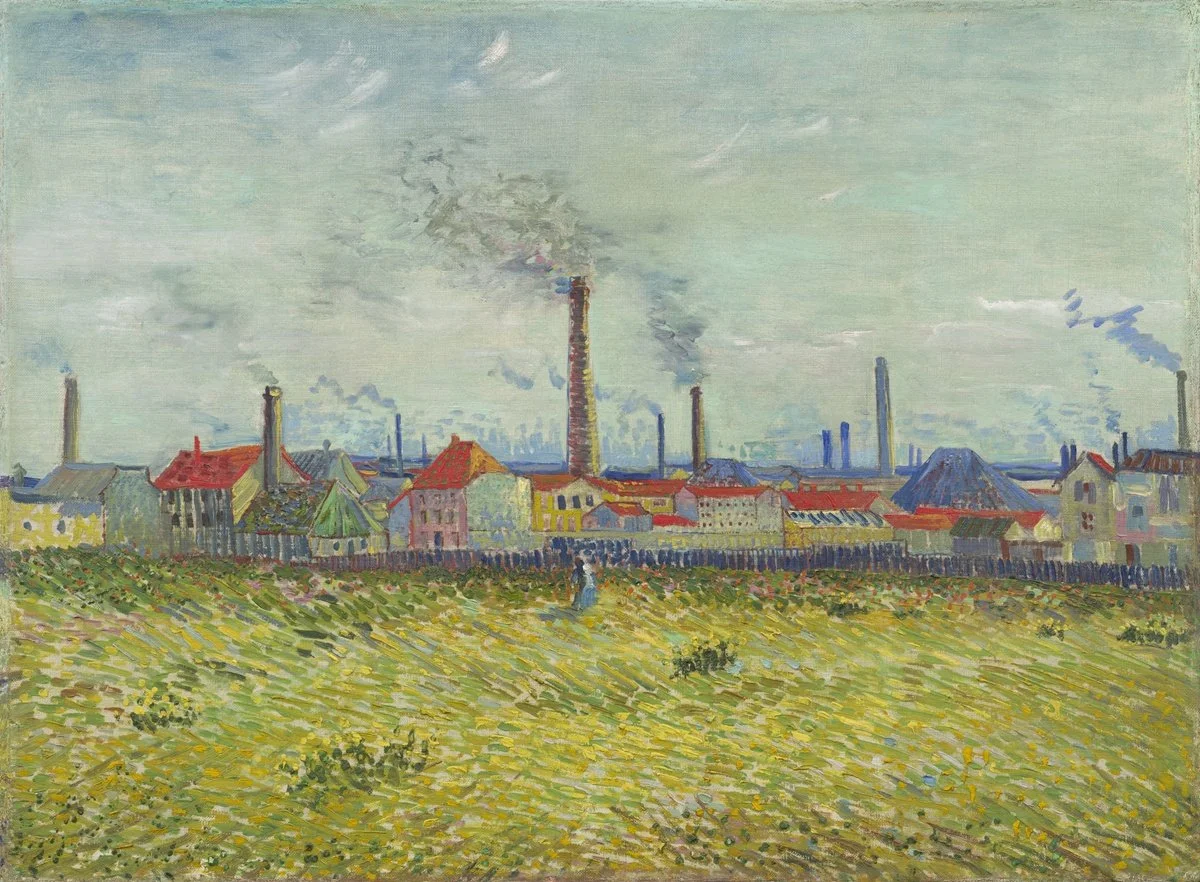
Factories at Clichy by Vincent Van Gogh, 1887 (public domain - St. Louis Art Museum)
“What else than a natural and mighty palimpsest is the human brain? Everlasting layers of ideas, images, feelings, have fallen upon your brain softly as light. Each succession has seemed to bury all that went before. And yet, in reality, not one has been extinguished.”
There is a scene in The Twilight Zone that deserves to be far more famous than it is.
In “The Brain Center at Whipple’s,” a CEO named Wallace Whipple has decided to replace his factory workers with machines. His chief engineer, Hanley, pushes back with the kind of moral clarity that leaders rarely permit in subordinates:
“Tell me, Mr. Whipple, why are you so eager to replace men with machines? Did it ever occur to you that you might be trading efficiency for pride?”
Whipple is contemptuous.
“Pride?!?”
“Yes, pride, Mr. Whipple! Craftsmanship. What a man feels when he makes something.”
“What the devil can I do with pride? Can I can it? Bottle it? Wrap it? I'm not selling pride, I'm selling product.”
Hanley presses further, invoking Whipple’s father — the founder, a man of different instincts:
“Nobody ever accused him of inefficiency, but he had something else on his mind.”
“What else did my father have on his mind, Mr. Hanley?”
“Goodwill. And the welfare of the people who worked for him.”
Whipple dismisses him. The machines go in. Hanley is let go. Progress, it seems, has been achieved.
And then, in the episode’s quiet devastation, Whipple himself is replaced. The board, as cold as the logic he’d preached, informs him that his position has been automated. He finds Hanley at a local bar and, with remarkable lack of self-awareness, rails against the injustice of it:
“It’s not right, Hanley, it’s not right. Cold, dispassionate, impersonal… they chuck a man out right in his prime — chuck him out like he was some kind of a part! Said I was neurotic about things. Said that being alone with the machines had warped me…”
Rod Serling wrote that episode in 1964. He was watching the first great wave of industrial automation — and he understood something that our era has yet to learn. Whipple is not a villain. He is a man who adopted a philosophy without counting the cost, who optimized himself right out of the moral imagination, and who did not notice until the logic he'd championed was turned against him.
We are all, in some measure, living in Whipple’s world now.
Lower-Value Human Capital
Last month, Standard Chartered CEO Bill Winters addressed investors with a phrase that would have made even Whipple pause: his company, he explained, was not cutting costs so much as
“replacing in some cases lower-value human capital with the financial capital and the investment capital we're putting in.”
Lower-value human capital.
Sit with that for a moment. The de-humanization of individuals to data points on a chart, as decimal points in a financial statement.
The words landed badly enough that by the next morning Winters had sent a memo to his employees assuring them that
“where roles do fall away, it reflects changes in the work, not the value of our people.”
One can only wonder what the people whose roles had already fallen away made of that particular reassurance. The memo is the modern equivalent of Whipple’s speech to Hanley — an attempt to retain the vocabulary of human dignity while executing a strategy that has already discarded it.
This is not an isolated incident. It is increasingly the lingua franca of an era.
Amazon’s mass layoff initiative was christened “Project Dawn” — a branding choice that deserves its own chapter in the history of corporate euphemism. Tens of thousands of employees learned their fates through calendar invitations and Slack speculation as the sun came up.
No conversation. No dignity. Just confusion at scale, delivered with the efficient impersonality of a system that had, somewhere along the way, stopped remembering that people were at the other end.
Thomas De Quincey wrote in 1845 that the human brain is a palimpsest — a piece of writing material that has been used, erased, and reused — that those layers of experience, memory, and feeling stacked upon one another, each apparently buried but none truly extinguished.
The danger of delegating our thinking, our judgment, our empathy to machines is not merely that we will make worse decisions. It is that we will become worse thinkers — flatter, less attuned, less capable of the lateral understanding that makes compassion possible. We will lose the very strata that make us human.
AI doing our thinking for us doesn’t just make us lazier. It erases the layers. Or worse: creates conditions such that we never have to create those layers in the first place.
A Man Has Value
The encyclical Magnifica Humanitas, issued by Pope Leo XIV last week, is the most comprehensive moral argument against the current trajectory of AI that any major institution has produced. At over 40,000 words, it is a document that — as one observer noted — should shame many professional technology journalists who have preferred credulous access reporting to the harder questions the pope is now demanding we ask.
In its core argument, it is Whipple’s lesson written in theological language. Or Winters’ statement “Where roles do fall away, it reflects changes in the work, not the value of our people,” rephrased. The encyclical answers that framing with something more philosophically durable: human dignity does not depend on the work you perform. It precedes it. It exists just as the air we breathe and cannot be optimized away.
The encyclical names as “particularly insidious” the ideology that every person must earn or justify their worth through efficiency — that those who produce more matter more. This is not merely a spiritual error. It is the operating assumption of a great deal of contemporary management practice, and it is producing predictable results. G.M Ivey summarizes Leo’s argument: “Stop treating human labor as a corporate liability.” The phrase lands with such force precisely because it shouldn't need to be said.
That this argument is being made by a pope rather than a CEO is itself instructive.
What’s in a Name — Revisited
A year ago, on the day of his election, this newsletter noted that Cardinal Prevost’s choice of the name Leo XIV carried specific historical weight. Leo XIII had been the Social Pope, the Pope of the Workers — the man who, in his 1891 encyclical Rerum Novarum, had insisted that the proclamation of the Gospel could not overlook the concrete lives of people. To take that name, we suggested, was to presage a mission that would be “thoughtful, inclusive, and humanitarian.”
Magnifica Humanitas is the fulfillment of that prediction — and then some. It positions itself explicitly as a successor document to Rerum Novarum, written on that encyclical’s 135th anniversary.
Where Leo XIII addressed the new things of industrial capitalism — the displacement of workers, the concentration of power in private hands, the moral accountability of those who hold economic leverage — Leo XIV addresses the new things of our moment: AI, algorithmic management, data extraction, and a small class of transnational technology companies whose resources exceed those of many governments.
The structural parallel is exact. The moral argument is unchanged. What has changed is the scale of what’s at stake.
Steve Inskeep, reflecting on the encyclical’s language, notes that Leo XIV uses the word colonialism to describe how AI is reshaping the balance of power — noting that data about ordinary people has become “the new ‘rare earths’ of power,” extracted from entire regions by platforms that answer to no electorate and whose values are those of their shareholders.
This is a harder charge than most secular critics have been willing to make, and it is worth contemplating.
The Palimpsest We’re Erasing
Steve Wozniak, speaking to graduates recently, offered his own version of this argument with characteristic directness. Reflecting on decades spent with engineers trying to recreate human cognition in software, he reminded the graduating class that they already possess what the machines do not: actual intelligence.
The most reliable method for producing a brain, he observed, still takes nine months. He urged students to think independently — to resist treating AI as a substitute for genuine understanding and intuition.
This is De Quincey’s palimpsest argument in commencement speech form. Every layer of genuine thinking, genuine feeling, genuine encounter with difficulty and ambiguity — these are not overwritten by what comes next. They form the substrate on which wisdom is built. When we outsource that process, we don't gain efficiency. We lose depth. We arrive at more answers and fewer insights.
The Ringer’s Brian Phillips, in a piece that manages to be both funny and genuinely alarmed, puts it simply: the problem with the tech industry isn’t a messaging problem:
“When you launch a product that's designed to put millions of people out of work, block access to sources of verifiable truth, replace human creativity with slop, and lower the barriers to every sort of atrocity, the problem isn't that you haven't told the public a good story about those things. The problem is that you are trying to do them.”
There is no algorithm for that kind of accountability.
Nehemiah’s Section of the Wall
Magnifica Humanitas offers two biblical images as its organizing framework: the Tower of Babel and the rebuilding of Jerusalem under Nehemiah.
Babel, the encyclical argues, is not merely a story of divine punishment. It is a story of what happens when a great project is built on uniformity rather than communion, on efficiency rather than dignity, on the ambition to “make a name” rather than to serve. The result is not unity but dispersion. The languages fracture. The project collapses under the weight of its own scale.
Nehemiah offers the counter-vision. Arriving at a ruined Jerusalem, he does not impose a top-down plan. He convenes the families. He assigns each of them a section of the wall. He listens to their concerns. He makes everyone accountable for their piece, and no one accountable for everything. The city is rebuilt not through one man’s efficiency but through shared, human, distributed responsibility.
This is not merely a theological model. It is the Working Together™ Leadership & Management System described in theological language. Every section of the wall belongs to someone. No one is a resource. No one is lower-value human capital. Everyone has a section, and everyone is responsible for it, and the city rises because enough people take that responsibility seriously enough to show up.
The great failure of the Whipple model — and its contemporary equivalents — is not that it replaces workers with machines. It is that it mistakes the product for the purpose.
Whipple’s father understood that the company existed for the people. The machines existed for the company. When you invert that hierarchy, you do not simply lose goodwill. You lose the organizing principle that made the whole enterprise worth building in the first place.
The Work No Machine Can Do
Alan Mulally arrived at Ford in 2006 and did something that no algorithm would have recommended: he made every leader in the room stand behind a red, yellow, or green status on their piece of the plan. No hiding behind dashboards. No automated summaries. A human being, accountable to other human beings, in real time. The discomfort was the point.
That friction was the trust.
The best leaders — and the encyclical is making this argument in universal terms — are not those who eliminate the difficulty of human interaction. They are those who embrace it. Those who remain present within it. Who sit with bad news. Who close the loop not because a metric flagged an engagement dip, but because a person told them something that mattered and they chose to act on it.
AI can process information faster than any human. It can identify patterns, generate options, summarize complexity. These are genuine capabilities, and pretending otherwise is its own kind of foolishness.
But it cannot be accountable. It cannot be responsible. It cannot take the call when someone's section of the wall is falling and decide that the relationship matters more than the efficiency of the outcome. It cannot, in Whipple's forgotten father’s phrase, hold goodwill and the welfare of people in mind.
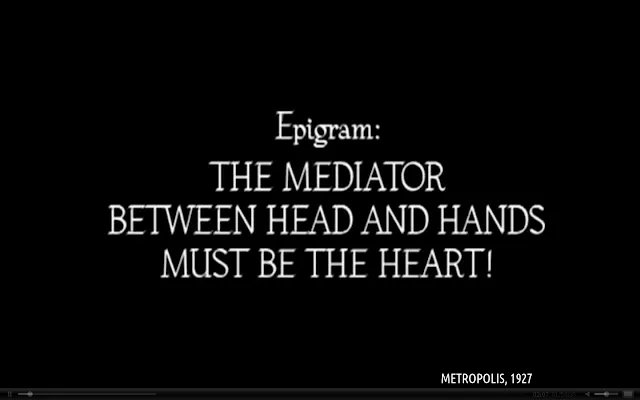
Meaning is still the work of human hands.
And in an age that is very rapidly convincing itself otherwise, insisting on that truth is not sentiment. It is resistance.
There is no algorithm for life. There is no optimization function for dignity. The question before every leader, every organization, every person building or deploying or simply using these technologies is the oldest question in management and in moral philosophy alike.
Are we treating people as ends, or as means?
Whipple learned the answer the hard way. The Standard Chartered CEO is learning it in real time. Leo XIV is asking the whole world to learn it before it's too late.
There’s so much to learn,
