
The Stories We Tell Ourselves
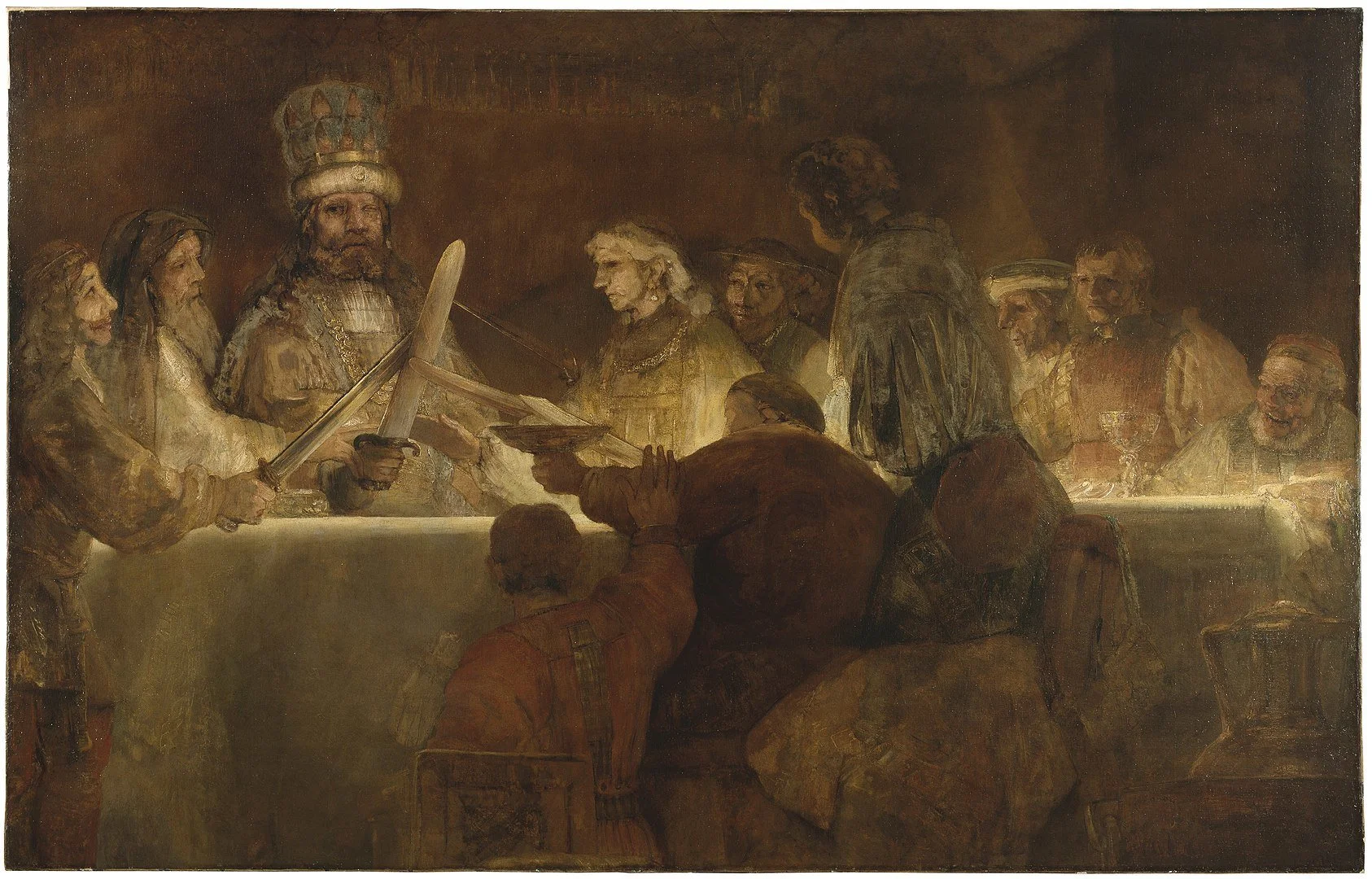
The Conspiracy of Claudius Civilis by Rembrandt, 1661 (public domain - Wikipedia)
“In most cases, men willingly believe what they wish.”
“It’s just the wind.”
You’ve probably thought that to yourself (or even said it out loud) when you were alone at home at night and heard an unexpected noise.
“It’s just the wind,” you say, as you try to convince yourself that there’s nothing to worry about.
Then, thinking that the wind couldn’t make that kind of a sound, you pivot: “Or maybe it’s a squirrel in the attic.”
You desperately want to try to outsmart the fear center in your brain. Maybe you succeed. Maybe you don’t. It depends on the kind of story you tell yourself.
Stories as Explainers
Aside from things that go bump in the night, the world can be a scary place.
Even now, amid advanced technology that connects us to each other's homes around the world, we don't know what the future will look like.
Imagine what it must have been like thousands of years ago, before calendars were in use, when weather forecasts were unheard of, and when we had no idea where we came from.
It’s human nature to want to simplify the complex, shape the world into a more orderly place, and make sense of things we don't understand.
So what do we do? We tell ourselves stories to explain away the inexplicable.
It’s been happening since we were first able to communicate. Humans developed myths, traditions, and stories that made sense out of a big and sometimes terrifying world.
“Myth has two main functions. The first is to answer the sort of awkward questions that children ask, such as ‘Who made the world? How will it end? Who was the first man? Where do souls go after death?’…The second function of myth is to justify an existing social system and account for traditional rites and customs.”
One of my favorite scenes from Disney’s 1940 classic Fantasia is the mythology sequence (no doubt because of my background both as a classics major and a devotee of Beethoven). It’s set to Beethoven’s Symphony No. 6, “Pastoral,” and in it, we experience an idyllic scene of centaurs, winged horses (recall there was only one original Pegasus), and Dionysus [Bacchus], the god of wine, all enjoying themselves.
Then the sky darkens and the dark clouds part, revealing an amused Zeus [Jupiter], who called to Hephaestus [Vulcan] to supply him with lightning bolts. The creatures scatter in fear, desperately seeking cover. Eventually, Zeus tires of this exercise, kicking off his sandals as he tucks in for a nap on a cloud. The storm recedes and a peaceful evening ensues.
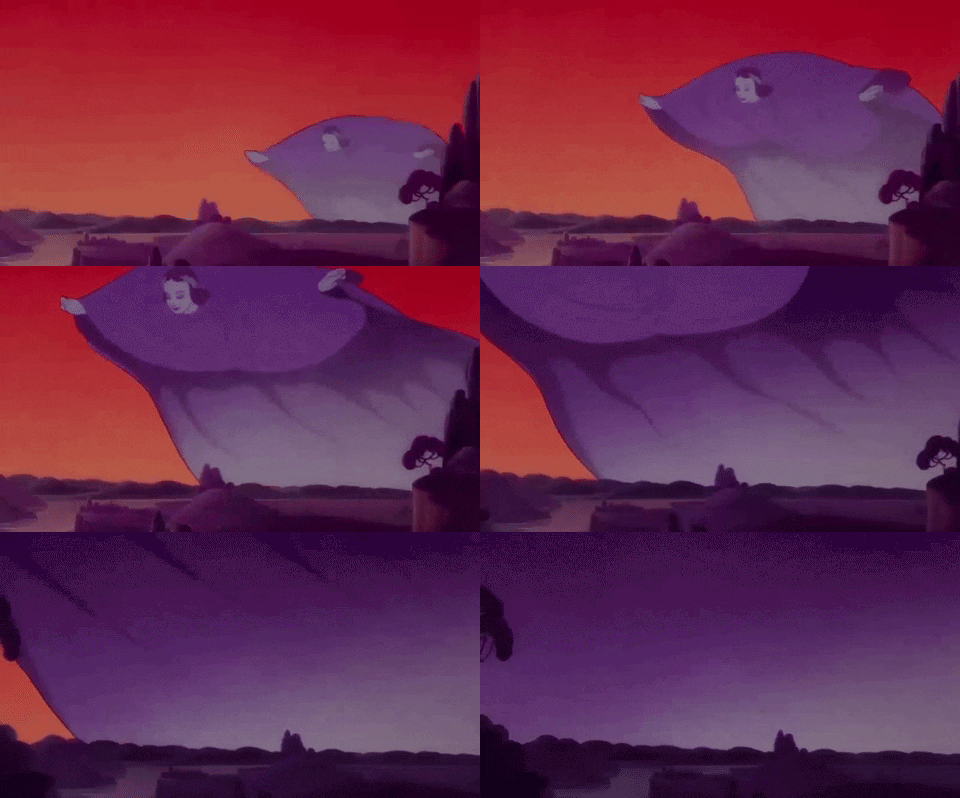
Nyx covers the sky
It’s a creative and illuminating mise-en-scène that literally illustrates how the ancients created stories to explain unexpected, unexplained, or confusing things in the world around them.
Modern Mythology
It shouldn’t be much of a surprise then, when surrounded by advanced technology — incomprehensible to some and awe-inspiring to others, all of whom are grappling with the tumult and uncertainty — that modern-day myths arise in the form of conspiracy theories.
From the moon landing to chemtrails, the suspicions that land on Freemasons to the desperate rantings of Flat-Earthers, the dangers of vaccinations and fluoride, and the sore-loser election-rigging claims, you can find people who are willing to believe fanciful stories that seemingly explain everything to them.
Everything is a conspiracy theory when you don’t understand how anything works.
The best leaders know how to rely on facts and data to guide their teams forward. It’s how I help them understand and implement the Working Together™ Leadership & Management System that Alan Mulally has so graciously entrusted to me.
Danger arises when a leader is surrounded by sycophants. The best leaders include people with a variety of opinions, viewpoints, and experience, in order to arrive at a better plan.
When the guardrails are off and a person in power is never told “no,” they become isolated from reality, which in turn affects their ability to make decisions that affect the lives of others.
Populism Rejects Facts
It’s astounding to see the degree to which people will go to contort facts and logical thinking into crazy theories to fit their worldview.
It may be rooted in a lack of understanding of scientific principles. In her book Democracy and Truth, Sophia Rosenfeld finds that conspiracy theories flourish in societies where there’s a gap between the governing and the governed classes. When populism takes hold, the public “tend to reject science and its methods as a source of directives.”
Advances in modern science and technology call even more attention to the disparity between experts and non-experts, leading to the doubting of basic truths.
Thank Heaven We’ve Seen This Before
This isn’t necessarily a new phenomenon, though: in 1623, Galileo wrote about the same phenomenon in The Assayer, noting that his observations of the heavenly bodies were based on math:
“…what I had set forth was supported and proved by geometrical demonstrations; and such is the strength of men's passion that they failed to notice how the contradiction of geometry is a bald denial of truth.”
Galileo’s most significant challenge wasn’t wrestling with equations and figures. His was a battle for the mind, a struggle for a different perspective. He tried to convince people that the Earth revolves around the Sun, but rather than other scientific defenses, he was met with powerful emotions and biases — powerful defenses that prevented others from seeing the truth.
When we let our emotions overpower facts, we miss the opportunity to be enlightened.
In trying to persuade others, the best efforts take into account emotions, making our audience feel a certain way, creating the desire to change. When backed by facts, it’s even more powerful.
Isn’t this what the best stories do? They’re vessels for information that create an emotional connection.
“Courage is resistance to fear, mastery of fear, not absence of fear.”
The world is complex. And we have experts who make it their business to try to understand it. We ought to put our trust and faith in them. There's no need to make up stories about things in order to assuage our fears.
The best antidote to fear is dealing with reality.
Anecdotes can come later.
There’s so much to learn,
