
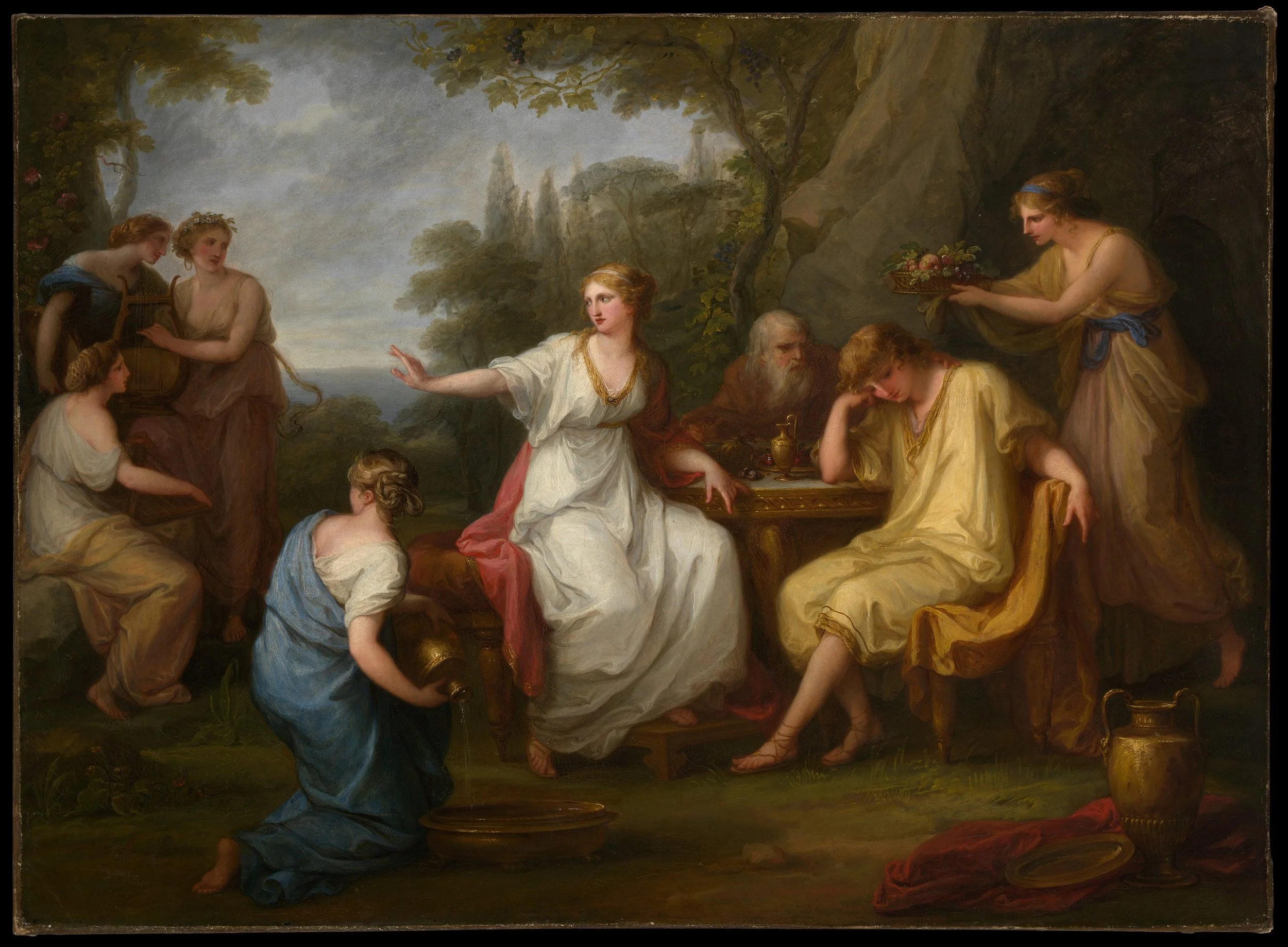
The Sorrow of Telemachus by Angelica Kauffmann, 1783 (public domain - Metropolitan Museum of Art)
“To love at all is to be vulnerable. Love anything and your heart will be wrung and possibly broken. If you want to make sure of keeping it intact you must give it to no one... The only place outside Heaven where you can be perfectly safe from all the dangers and perturbations of love is Hell.”
Every age flatters itself by believing it is uniquely cursed.
Ours insists that cruelty is realism, that cynicism is wisdom, that loving too freely marks you as unserious—or worse, naïve. We are told, subtly and relentlessly, that belief in goodness is a luxury item, something to be set aside when the world grows hard. That love is soft. That giving without expectation is for suckers.
History, of course, says otherwise.
The most durable civilizations — those that lasted longer than a news cycle or a quarterly earnings call — were built not on fear, but on shared belief. On the stubborn conviction that human beings are more than their worst instincts. That decency is not accidental and that goodness, practiced daily, compounds.
To believe in good is not to deny evil. It is to refuse to let evil set the terms.
If any of this matters to you — even the slightest bit — please sign up and share. Timeless values like this are what keep us going, and we need each other’s support and love.
Make sure you scroll all the way to the end — there’s a video that hammers this point home.
The Strength We Keep Forgetting
We’re told that love is patient, yet we get distracted because hate is loud. And that asymmetry confuses us.
Hate announces itself in absolutes and slogans, promising speed. It feels like action. Love, by contrast, works slowly, invisibly, through habits and choices that rarely make headlines. It builds trust, then institutions, then cultures — often without applause.
A frustrating timeline for those who wish to make an immediate difference. But hate burns hot and fast. Love endures.
“To ravage, to slaughter, to usurp under false titles, they call empire, and where they make a desert, they call it peace.”
Tacitus observed that “they make a desert and call it peace.” Hatred does the same thing to organizations, families, and nations. It clears the ground, yes — but leaves nothing worth inheriting. Love, inconvenient as it may be, is how anything worth keeping survives.
This is not sentimentality. It is structural truth.
You cannot build a functioning enterprise, a resilient culture, or a just society on contempt. Fear produces compliance; love produces commitment. One collapses the moment pressure is released. The other holds when things go sideways.
Every serious leader eventually learns this, usually the hard way.
I help leaders and their teams discover how to operate with love and humility to create value and growth for all through Alan Mulally’s Working Together™ Leadership & Management System. I experienced it firsthand and practiced it when I served with him as an executive at Ford Motor Company. And now I can help you and your team — at companies of any size — do the same.
The Radical Act of Giving
Giving without expectation feels subversive because it refuses the dominant logic of transaction.
We live in a culture obsessed with leverage: What do I get out of this? How do I protect myself? Where is my return? These are reasonable questions in markets obsessed with the bottom line.
They are corrosive ones in human relationships. And isn’t every organization made from human relationships?
The ancient Greeks understood this better than we do. Charis — grace freely given — was not weakness. It was social glue. It created obligation not through force, but through gratitude. It bound people together because it was voluntary.
When you give without expectation, you do something quietly radical: you assert that the relationship itself matters more than the outcome. That trust is not foolish. That generosity is not a strategy, but a stance.
Ironically, this is how the strongest systems are formed. The most resilient teams. The deepest loyalty. The cultures people refuse to abandon when things get difficult.
What is given freely is often returned — just not on your timetable, and not in your currency.
Choosing the Longer Views
Believing in good, loving in a cynical age, giving without keeping score — these are not passive acts. They are choices we make daily. And they’re often lonely ones.
They require faith in something unfashionable: the long view.
They require us to believe that how we treat people matters even when no one is watching. That the moral shortcuts on offer—humiliation, indifference, cruelty—always come with hidden costs. That dignity, once lost, is difficult to recover.
We are not the first generation tempted to abandon these beliefs. But those who did rarely left behind anything worth admiring.
The truth, inconvenient and enduring, is this: love is stronger than hate because it creates. Hate can only destroy. Good is essential because without it, nothing lasts. And giving without expectation is how we remind one another that we are not merely consumers of each other—but stewards.
That may not trend. It may not scale quickly. But it has always been how the future is made.
Quietly. Patiently. On purpose.
There’s so much to learn,
