
Snowy Reflections
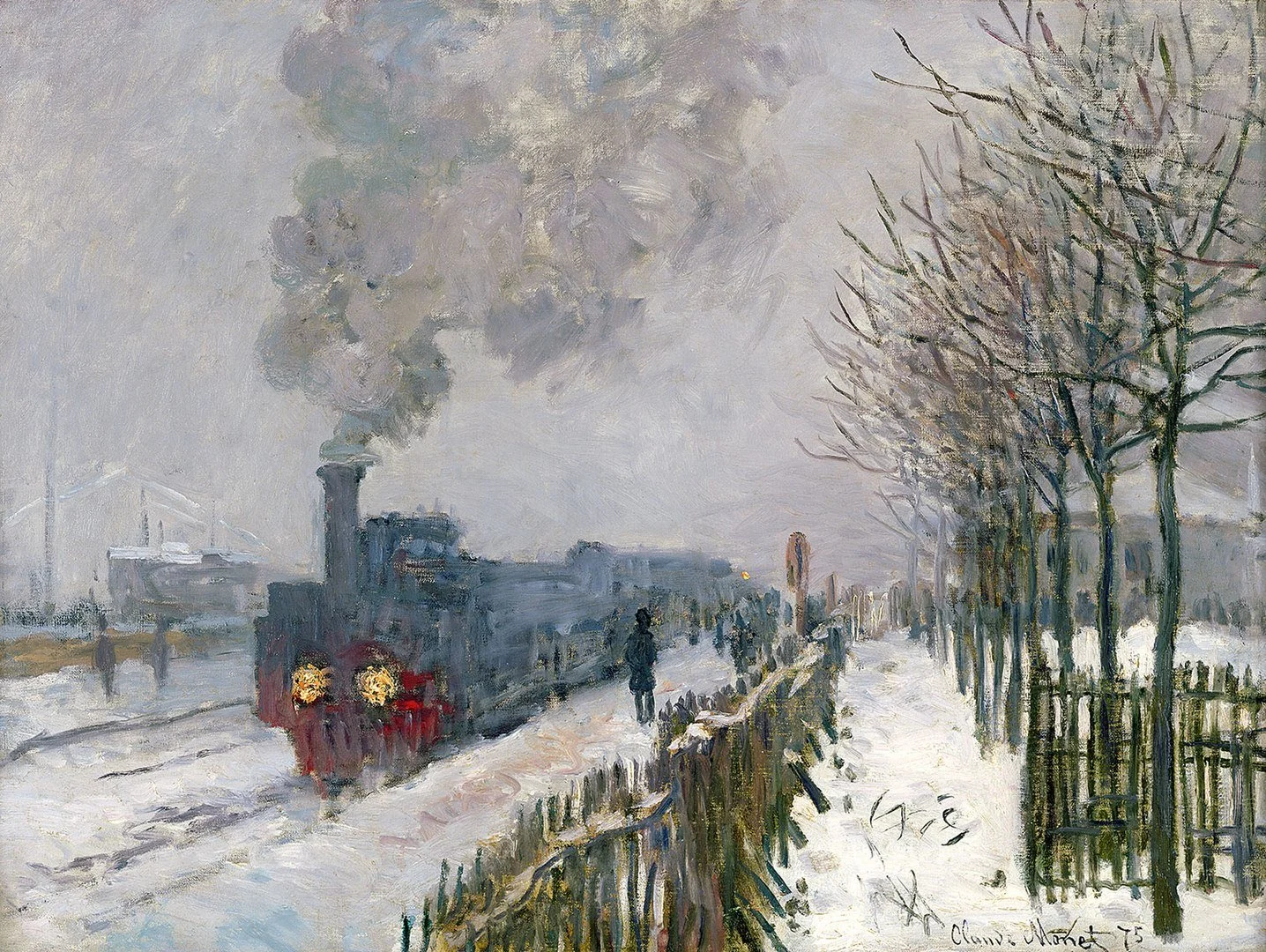
The Train In the Snow by Claude Monet, 1875 (public domain - Wikipedia)
“When you get what you want in your struggle for pelf,And the world makes you King for a day,Then go to the mirror and look at yourself,And see what that guy has to say”
It snowed here over the weekend. It wasn’t a notable amount, but just enough to put a pause in the usual cadence of things.
I enjoy those fleeting hours of the late night when the snow is still falling but has lightened up a bit. I’m usually the last one up, so I have the house to myself as I look out into the faint white glow in the yard. Like the smell of summer rain, the sound — or rather the absence of it — in the snow is familiar and welcoming.
As morning breaks, I hear the buzz of snowblowers in the neighborhood, the scraping of heavy plows in the street, and I have an awareness of fewer cars on the road: the wiser and less burdened among us staying home rather than venturing out into the slippery mess.
It’s odd, isn’t it, how the snow creates a strange sense of calm and quiet? There are reasons for this frozen meditation undertaken by Mother Nature in the colder months, and with them, some lessons for us as well.
The frozen quiet dominates partly because we stay in, as do the birds — they naturally hunker down during stormy weather. But more than that, the structure of the snow absorbs sound. Snowflakes are six-sided crystals, and as they cling together, they form small pockets of air — perfect sound wave absorbers.
With Silence Comes Reflection
The holiday time becomes a time of natural reflection as well, as it tends to be slower and quieter. As such, this is a time when any leader has the opportunity to reflect on how you’re feeling, how your team is handling things, and what changes you can make to improve your output.
I regularly work with teams to help them assess their strengths and opportunities that can help them excel, as well as the threats and weaknesses where they may have blind spots. Can I help your team? Let’s set up a quick call to explore what’s holding you back.
Leadership, like history, is best understood as a mirror: it reflects the bearer’s character more than it reveals any grand strategy or noble purpose. We speak of leaders as if they were anointed by heaven, inheritors of charisma, vision, and command.
Yet more often than not, the failure of an enterprise — whether of state, commerce, or conscience — can be traced not to the inadequacy of the masses, but to the deficiencies of the one standing at the head of the table.
We are all human. And sometimes we need a wake-up call alerting us to what we need to improve in ourselves. Maybe you do well in all of the areas below; perhaps you have more than one that needs improvement. Either way, this is your opportunity to learn and grow.
Twelve Leadership Reflections for December
1. If your team is failing, look into the mirror. You may be the problem.
It is the leader’s reflection that governs the tone and temper of the group. A demoralized, confused, or fearful team often mirrors the insecurities of the one meant to lead them.
Consider Louis XVI, whose indecision helped hasten the guillotine’s rise; or Captain Bligh of the Bounty, whose tyranny bred mutiny.
The leader who seeks scapegoats among the ranks betrays an unwillingness to confront the most intimate battlefield: the self.
2. If you can’t handle criticism, you may not be fit to lead.
The Greeks understood parrhesia — the courage to speak truth to power — as a moral duty. The modern executive might do well to resurrect that virtue.
The leader who dismisses dissent or punishes candor is not a leader but an autocrat in miniature. Lincoln surrounded himself with rivals; Churchill demanded argument.
A fragile ego builds a fragile institution.
3. Your title makes you a manager; your people make you a leader. Don’t confuse the two.
Napoleon crowned himself emperor, but it was his soldiers who made him a legend. Leadership, stripped of its ceremonial trappings, is not conferred by the boardroom or ballot but earned, daily, through trust and example.
A manager moves pieces on a board; a leader moves hearts. The distinction, as every weary worker knows, is not semantic but existential.
4. Don’t preach teamwork and then play favorites. Hypocrisy kills culture.
In the hierarchy of human resentment, few poisons spread faster than unfairness. The leader who rewards sycophants while ignoring merit corrodes the very spirit he claims to cultivate.
Shakespeare’s King Lear trusted the flatterers and banished the honest; what followed was ruin. Hypocrisy, like dry rot, hollows the foundation from within.
5. Stop micromanaging. If you don’t trust your team, why should they trust you?
The micromanager’s delusion is control; his legacy is resentment. Michelangelo was once asked how he sculpted David. “I saw the angel in the marble,” he said, “and carved until I set him free.”
The good leader does likewise — reveals the potential within others by removing excess interference. To hover, to second-guess, to rewrite every memo is to confess that one’s leadership is ornamental, not operational.
6. If you’re not developing your team, you’re diminishing them. Step up or step aside.
A true leader is a gardener, not a gatekeeper. The failure to nurture others’ growth is the slow strangulation of potential. Elizabeth I surrounded herself with capable advisors; she was great not because she ruled alone, but because she ruled among greatness.
The insecure leader, by contrast, hoards competence, mistaking dependency for loyalty.
7. If your team is afraid to speak up, you’ve already failed as a leader.
Fear is the enemy of truth. Organizations that punish candor soon become echo chambers of delusion. The Soviet Union produced no shortage of five-year plans precisely because it produced no safe space for honest feedback. Better a single inconvenient truth than a thousand comfortable lies.
8. If you’re not accountable, you’re not credible. Own your mistakes.
When Richard Nixon declared, “I am not a crook,” it was already too late. Accountability, once surrendered, cannot be reclaimed through words alone.
The strength of a leader is not measured by perfection but by the grace with which he admits imperfection. Failure confessed is failure redeemed.
9. Don’t just set the pace; set the standard. Excellence is contagious.
The Renaissance flourished not through decree but through example, with masters inspiring apprentices by their craft. In any enterprise, standards trickle down from the top; mediocrity, too, has a way of replicating itself. If the leader cuts corners, the team will learn to measure success in inches, not ideals.
10. Your team doesn’t work for you. You work for them. Serve to lead.
This inversion of the hierarchy — so radical in theory, so rare in practice — lies at the heart of moral leadership. The best rulers, from Marcus Aurelius to Mandela, understood service as the measure of greatness.
The Latin dux meant “to lead,” but its root sense was to guide, not to dominate. The office exists not for privilege, but for stewardship.
11. If your actions don’t inspire, your words won’t. Lead by example.
Words divorced from conduct are the empty calories of leadership: sweet in the moment, sustaining nothing. When George Washington resigned his commission after the Revolution, he taught a nation more about power’s restraint than any proclamation could. Example is the only sermon that needs no pulpit.
12. A leader takes the blame and shares the fame. No exceptions.
To take the blame is to shoulder the moral weight of command; to share the fame is to recognize that glory is collective. Roosevelt thanked his “boys” at San Juan Hill; Shackleton returned every man from the Antarctic alive.
These are not footnotes of humility but testaments of character. The leader who reverses the equation—claiming the laurels, disowning the failures—may win a season’s applause, but not history’s respect.
Summed up, here are the 12 reflections:
If your team is failing, look into the mirror. You may be the problem.
If you can’t handle criticism, you’re not fit to lead.
Your title makes you a manager; your people make you a leader. Don’t confuse the two.
Don’t preach teamwork and then play favorites. Hypocrisy kills culture.
Stop micromanaging. If you don’t trust your team, why should they trust you?
If you’re not developing your team, you’re diminishing them. Step up or step aside.
If your team is afraid to speak up, you’ve already failed as a leader.
If you’re not accountable, you’re not credible. Own your mistakes.
Don’t just set the pace; set the standard. Excellence is contagious.
Your team doesn’t work for you. You work for them. Serve to lead.
If your actions don’t inspire, your words won’t. Lead by example.
A leader takes the blame and shares the fame. No exceptions.
Leadership, then, is not a science of efficiency but a moral art — an experiment in self-knowledge conducted in public view. It demands less the mastery of others than the mastery of one’s own appetites: for control, for credit, for comfort.
The great failing of our age is to confuse authority with virtue, noise with wisdom, charisma with character. But the mirror remains — unblinking, unforgiving, true.
The question, as ever, is not whether we lead, but whether we dare to look at ourselves first.
There’s so much to learn,
