
Does Character Still Matter?
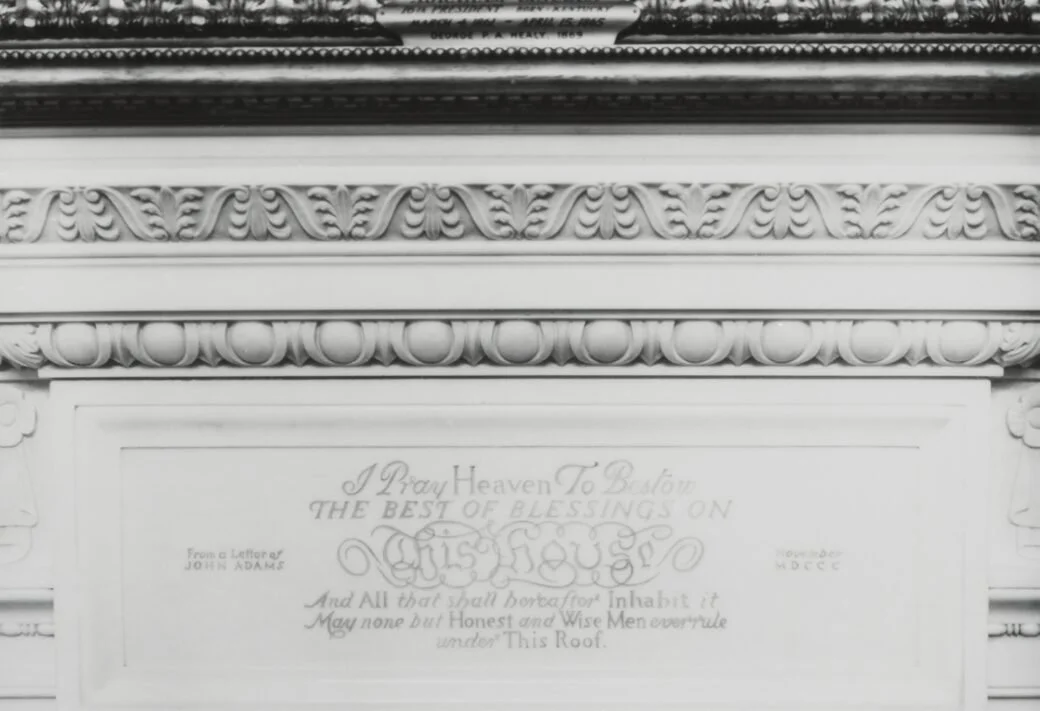
John Adams’ Blessing Carved into the State Dining Room Mantel by Michael Geissinger, c. 1945 (public domain - White House Historical Association)
“It’s not by strength or speed or swiftness of body that great deeds are done, but by wisdom, character, and sober judgment.”
Yesterday was Veterans Day, which brought to mind the selfless service of so many men and women in the armed forces, standing up for a principle more powerful than any single person.
In his celebrated commencement speech at West Point in 1962, General Douglas MacArthur noted the motto of the school (“Duty. Honor. Country.”) contained virtues that were important because “they build character.”
For me, character has been a guiding light for as long as I can remember. It began at home, where kindness, curiosity, humility, and gratitude weren’t just words — they were expectations.
It continued through involvement in civic programs that shaped me: participating in the Boy Scouts, attending Boys State, and even extending to the time I spent working at Veterans Affairs where I encountered veterans who believed that service was not a slogan but a sacrament.
Lately, though, it feels as if we’re witnessing a collapse of character — not a quiet erosion, but an outright abandonment. Leaders who once might have been shamed for deceit or cruelty now flaunt it, as if audacity could substitute for ethics.
Under This Roof
“Public virtue cannot exist in a Nation without private Virtue, and public Virtue is the only Foundation of Republics.”
John Adams understood better. When he first arrived at the White House on November 1, 1800, he arrived unceremoniously, with only his secretary in tow. The Executive Mansion was still unfinished, the plaster was still wet and only a handful of rooms were ready.
On that first evening in the sprawling place, he wrote a now-famous letter to his wife Abigail. It included the following two sentences, which Franklin Roosevelt had carved into the mantel of the State Dining Room:
“I Pray Heaven To Bestow The Best Of Blessings On This House And All that shall hereafter Inhabit it. May none but Honest and Wise Men ever rule under This Roof.”
He knew, as the ancients did, that the strength of any republic resides not in its fortifications or wealth, but in the mettle of those entrusted to lead it. He nominated Washington not because the man was perfect, but because he was principled; he recommended Jefferson to write the Declaration not because he was agreeable, but because he was capable.
And now that building has been defiled with gilded effrontery, saying more about the current occupant’s character than any speech or proclamation ever could.
Frederick Douglass, nearly a century after Adams, reminded us that the character of our leaders matters — that a president should be someone future generations can look to as a model.
In his “Speech on the Issues of the Presidential Election, 1888,” Douglass wrote this about character:
“In a Presidential canvass three things are always in order: First, we have to consider the character of the candidate… A man in the presidential chair should stand for something more than a lucky and successful politician. He should be one among millions—a model man; one to whom the sons of after-coming generations can be referred as an example to them.”
That idea feels almost radical today.
Presidential Immunity
Last year, following the Supreme Court ruling on presidential immunity, President Biden reminded us of the importance of character in our leaders:
“You know, at the outset of our nation, it was the character of George Washington, our first president, that defined the presidency. He believed power was limited, not absolute, and that power would always reside with the people — always.
Now, over 200 years later, with today’s Supreme Court decision, once again it will depend on the character of the men and women who hold that presidency that are going to define the limits of the power of the presidency, because the law will no longer do it.”
I can’t help but think back to my own early lessons: the veterans, the mentors, the civic leaders, all of whom believed that the health of a democracy depends not on its laws alone, but on the moral fiber of its citizens.
We need to recover that belief. To show our children that leadership isn’t about charisma or popularity, but about integrity, courage, and service to others.
“History has shown us that character counts. Character above all.”
To believe in character now may seem a quaint relic from another age. Yet, if our public life is to mean anything at all, we must hope — and act — as if it still matters.
There’s so much to learn,
