
Welcome to “Off the Clock,” a little something that lands somewhere between Timeless & Timely.
I send out this fun look at language and words every other Saturday as bonus content. If someone sent this to you, please consider subscribing.
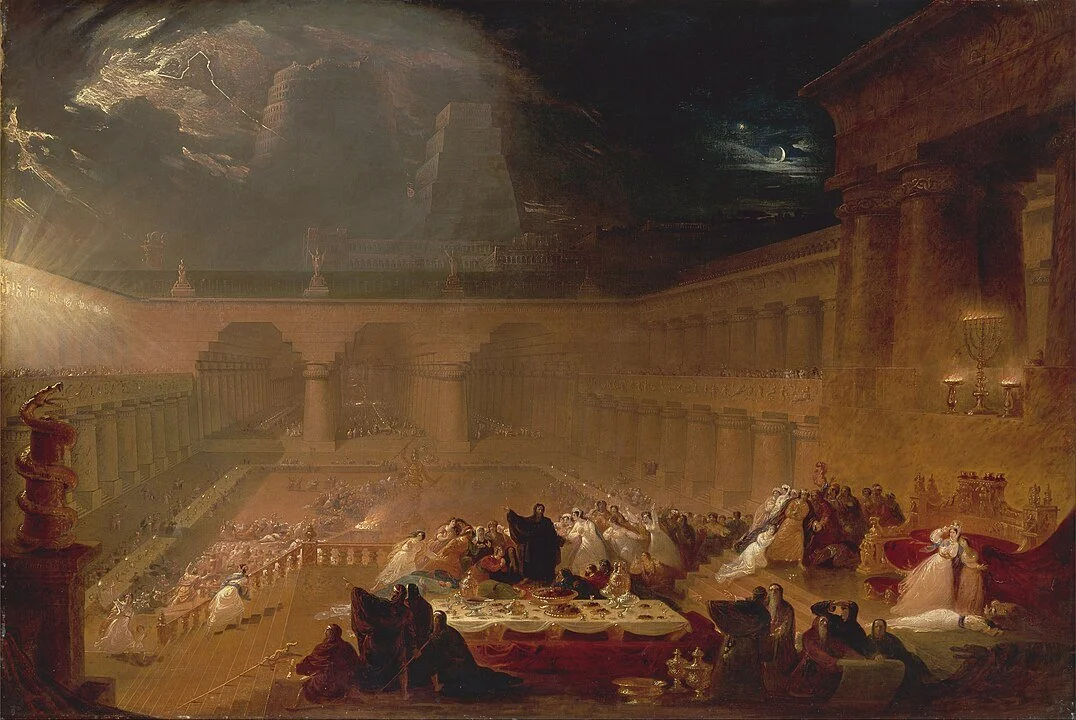
Belshazzar’s Feast by John Martin, c. 1821 (public domain - Wikipedia)
It began, as so many historical inquiries do, with a late night snack.
Last night, while raiding the remains of the Halloween loot, I unwrapped a Baby Ruth candy bar, and somewhere between the caramel and the guilt, I wondered: who was Baby Ruth?
The short answer: probably not Babe Ruth, though the Curtiss Candy Company would have liked the confusion. They claimed it was named for President Grover Cleveland’s daughter Ruth, who’d been dead for 17 years when the candy debuted. Sweet history, indeed.
That got me thinking: how many of the foods we eat every day carry someone’s name — a little edible monument to human vanity, ingenuity, or just plain luck? The history of these named dishes must be packed with some combination of practicality and comedy.
From dukes to doctors, divas to diplomats, the menu reads like a guest list at a particularly eccentric dinner party. Pull up a chair for these — you’re in good company (except perhaps #4).
Eight Dishes Named for Real People
1. Carpaccio: A Painter’s Palette
Our first course is as refined as it is raw. In 1950, Giuseppe Cipriani — founder of Harry’s Bar in Venice — created a dish of thinly sliced raw beef drizzled with a creamy mustard sauce for a patron who couldn’t eat cooked meat. The bright red of the beef reminded him of the crimson hues favored by Venetian painter Vittore Carpaccio, who lived some four centuries earlier.
As a bonus, Cipriani also created the Bellini, a cocktail made with Prosecco and peach nectar. Ever the art lover, he named it because its color reminded him of a painting by another local artist from the 15th century: Giovanni Bellini.
2. Chateaubriand: The Romantic Roast
François-René de Chateaubriand was a French writer, diplomat, and all-around Romantic hero. The kind of man who could sigh meaningfully in iambic pentameter.
His personal chef, Montmireil, supposedly devised a tenderloin preparation worthy of his employer’s sensibilities: a thick center-cut of beef roasted between two lesser pieces to retain its juices, then served with a rich wine sauce.
In the end, it’s hard to say which was more overdone — the prose or the beef.
3. Napoleon: Layers of Ambition
Ah, Napoleon. A man whose name evokes conquest, empire, and pastry. Pastry? The mille-feuille, or “thousand-leaf” puff pastry, became known as the Napoleon not for Bonaparte himself but likely for Naples (“Napolitain”) from which the style of dessert originated.7
Still, the association stuck. It’s easy to see why: many layers, delicate structure, and prone to collapse under pressure.
4. Graham Crackers: Sinless Snacking
You might want to sit down for this one, but preferably not at a campfire. The humble graham cracker began not as a vehicle for s’mores but as a weapon against sin — a specific kind of sin.